
Nature
Photography
Galleries
Landscape
Photography
Animal
Photography
& Small
Critters
People
Photography
Last update:
07/02/2022 12:25 PM -0400
All text and photography Copyright © Milton Heiberg Studios unless otherwise noted
Newsletter Click here for the Wetlands Photo Gallery
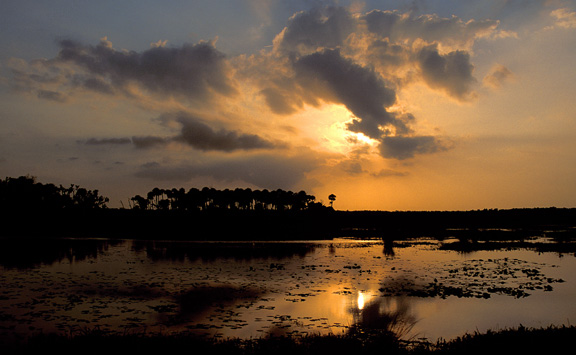
Orlando Wetlands, late winter afternoon
Orlando Wetlands Park
This is the story of how a major city killed two birds with one stone. Actually, birds proliferated, city wastewater was treated by Mother Nature’s own tools, and clean water was put back into the ecological system. The best part is that habitat was created for an abundance of wildlife.
I moved to Orlando, Florida, in 1998 for a variety of reasons. As a nature photographer one of the reasons being it was not too far from Merritt Island NWR, one of my favorite Florida hangouts. As an active Audubon Society member for more than twenty years in New York City, I continued that Audubon relationship by joining the society’s Orange County chapter here in Orlando. This is where I was introduced to a new concept in wildlife management. The concept of blending it with wastewater management. The Orange Audubon chapter had adopted, and promoted for public use, a project called "The Orlando Wetlands Park." They ran tours, education projects, and did a yearlong bird survey at the park.
My first visit to the "park" was on the advice of an Audubon member who suggested it simply because it was so close to my new home. I took the raves that I heard as proud embellishments and didn’t expect more than a relaxing day of moderate bird watching. I hiked along its 18 miles of berms without the knowledge of any association of wastewater. Hey! I was new in town, and as of then no one had told me. The park was the greenest and most alive wetland I had ever seen. The air was fresh and clean with no clue of wastewater that one would smell near a traditional reclamation site. I was floored when someone finally educated me.
I’ve been back many times since, and the photo subjects are good any time of the day. But at dusk the sky fills with birds coming in to roost from every direction. Hundreds of ibis and ducks in "V" formation cross the setting sun both close and far. There are several groups of leafless trees in the park; mostly live oaks that were killed by flooding when creating the wetland cells. Rather than remove them, the park’s designers opted to leave them standing to provide roosting perches for the birds. From across a pond, I watched one leafless grove fill with white ibis to the point where it looked like the trees were covered with snow. As I moved around the pond, I saw that the trees provided perfect unobstructed views of these avian models. Another grove of leafless trees filled up with black vultures. I thought to myself—this is a nature photographer’s dream!
When Walt Disney World was first built, the city of Orlando immediately became one of the fastest growing cities in the nation. Among its growing pains were two major problems. New construction sites for homes and commerce took away wildlife habitat; and the amount of wastewater from the city’s sewers increased proportionally. Like most cities in the United States, Orlando’s wastewater was treated through sixteen local treatment plants where it was put through settling stages and heavy chemical treatments. Water then went back into the ecosystem still containing a high level of phosphates, nitrates, and other nutrients, which created havoc with the ecology wherever it was dumped. In Orlando, this effluent water eventually made its way to the St. John’s River, which becomes the largest estuary in northeast Florida. Something had to be done.
The solution to this problem was a plan formed by the joint efforts of Robert C. Haven and Thomas L. Lothrop of the City of Orlando, Alex Alexander of the Florida Department of Environmental Protection, and Phillip E. Searcy of PBS&J, Inc., an environmental engineering firm. The original (and still official) name was "Orlando Easterly Wetlands Reclamation Project." The concept was a large-scale constructed treatment wetland whose main objective would be the purification of wastewater, but would have the strong secondary objective of creating a wildlife habitat with specific habitat types. Although it was not the first constructed wetland, it was unique as being the largest undertaking with such heavy wildlife considerations.
The site chosen for the final stages of reclamation was actually sixteen miles east of Orlando, near the town of Christmas, FL. This called for a pipeline to carry the effluent water from the city’s "Iron Bridge" facility (the initial treatment location) out to the site. The pipeline and the land acquisition came to more than half of the project’s $21.5 million cost. Needless to say, the project did have some political opposition, especially as it was considered an "experimental" project. This and a list of other problems were eventually overcome.
The "park" was completed in July 1987. The result is a very successful 1650 acres of land, of which 1200 acres were divided into 17 wetland cells separated by 18 miles of berm. The cells are comprised of three vegetative communities: a deep marsh (410 acres of mostly cattails and bulrushes), a mixed marsh (380 acres of over 60 submergent and emergent herbaceous species), and a hardwood swamp. The first two communities provide much of the nutrient removal as well as wildlife habitat. The third community (the 400-acre hardwood swamp) serves primarily as wildlife habitat. Also, the earth used for building the berms created a 75-acre lake as part of the park.
The effluent water enters the park’s wetland cells at the rate of 20 million gallons per day with still higher than normal levels with phosphates and nitrates. But what likes these nutrients better than vegetation? So, as the effluent water travels through the wetland cells, more than 2 million aquatic plants and 200,000 trees eat up these impurities. This flourishing plant life has become the bottom of the food chain for a very healthy ecological system that now boasts numerous animal species including otters, foxes, bobcats, deer, turtles, snakes, lots of alligators, and more that 170 species of birds. The list of endangered species that have been seen at the park include: the Arctic peregrine falcon (Falco peregrinus tundrius), wood stork (Mycteria americana), snail kite (Rostrhamus sociabilis), and the Florida panther (Felis concolor coryi), plus a list of endangered or threatened plant species too long to list here. The park was recently added to the list of birding hot spots for the state’s newly organized "Great Florida Birding Trail."
The park was a tremendous success and proved itself worthy of major recognition by other municipalities. To date there are more than 600 constructed treatment wetlands in the United States, and more on the drawing board. So far, in Florida, similar systems have been established in Brevard County, the cities of Titusville and Lakeland. Most of these projects, if not open to the public already, are being prepared for public recreational use.
In 1972, the rural town of Vermontville, Michigan (population 825), could not afford the costs of building or running a "high-tech" physical-chemical wastewater treatment plant to comply with the Clean Water Act. But they had eleven acres of the right kind of real estate for a six-stage natural treatment system. They built two facultative stabilization ponds followed by four seepage beds. To the surprise of the system’s designers, the seepage beds turned into active wildlife-supporting wetlands. By the early 1990s, the seepage beds became entirely overgrown with emergent aquatic vegetation, mainly cattail.
The earliest west coast wastewater wetland had somewhat irregular beginnings. In the late 1960s the town of Martinez, California (the Mt. View Sanitation District), was threatened with having to join a consolidation of small towns into a regional water quality control board’s large treatment plant at the cost of $6 million to the town. It also meant that the town wastewater officials would lose all control of wastewater management, and possibly their jobs. In the process of looking for ways to "sell" their wastewater to industries they found a loophole in the regulation stating that, if the effluent water was to benefit the environment, they would not have to comply with the regional plan. So, politically motivated, they built a 10-acre wetland. Over the years it has expanded to 85 acres, and supports wildlife that includes over 123 species of birds.
The city of Arcata, California, as early as 1969 had been successful in raising juvenile Pacific salmon and trout in mixtures of partially treated wastewater and seawater. By 1986 they had completed a 100-acre marsh from wastewater and saltwater marshes. Today, any well-travelled birdwatcher knows the "Arcata Marsh and Wildlife Sanctuary" in northern California. More than 200 species of migrating birds have been seen here. It is now recognized as one of the best birding sites on the Pacific North Coast.
Desert communities of Arizona have long used effluent water to maintain their golf courses, but more recently towns such as Tempe and Gilbert (two suburbs of Phoenix) are pouring this wastewater into newly created wetlands in their riparian preserves. Constructed wetlands have become popular, even in the desert, and there seems to be ample federal funding available. Tempe, Arizona, recently obtained $4.2 million of federal money while using $2.4 million of its own funds.
Considering that more than 100 million acres of wetlands have disappeared and given way to industry and farming in the United States, it’s nice to see that some of it is being given back. By the way, the site chosen for the "Orlando Easterly Wetlands Reclamation Project" was grazing pasture land that was originally converted from a natural wetland. There may be a wetland project, or at least a plan near your town. If not, you might consider contacting your local politicians.
The Orlando Wetlands Park is open to the public from dawn to dusk seven days a week from January 21 through September 30. It is closed from October 1 through January 20 due to a conditional clause in the previous owner’s contract of sale to the city of Orlando. Be aware of these dates if you plan to visit. For more information on the Orlando project write to Mark Sees, Wetlands Analyst at msees@intellistar.net. For information on constructed wetlands in general visit www.ci.orlando.fl.us (Florida), www.nwi.fws.gov, www.usbr.gov (western states), www.sws.org (wetland scientists), www.epa.gov/owow/wetlands/constructed/guide (a city planner’s guide).
Milton Heiberg